 BriefsFinance
The $47 Space Stock We Bought Before Washington Opened Its Wallet
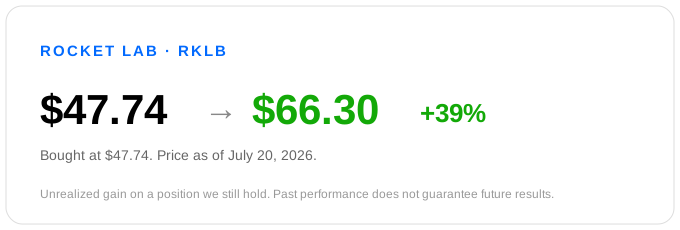
In 2025 we added a small public space company to our Briefs Portfolio at $47.74 a share, with our own money. As of today, July 20, 2026, it trades at $66.30, up about 39%. Here is how we found it.
Equity Research · Published July 2026
Right now, the U.S. government is pushing billions of dollars toward space.
Most people haven’t noticed. But the folks who catch a shift like this early are usually the ones who do the best.
When you hear “space stock,” you probably think of the giant defense contractors, or the one famous name everyone waited years to be able to buy.
That’s most people. But the giants are already huge, already expensive, and too big to move much on any one contract. We wanted something different. A smaller company, public, that you could actually own, and that was set up to win as the new space money started to flow.
So we asked one simple question. Which small company is quietly positioned to benefit when Washington starts spending on space?
The company we bought is small, public, and most people have never heard of it. We added it to our Briefs Portfolio at $47.74 a share, with our own money, and told our members why.
$47.74 → $66.30 · up about 39% · as of July 20, 2026.
And we still own it.
Now, one stock going up isn’t the point. Anyone can get lucky once. What matters is how it was found, because the same simple idea sits behind every pick we make.
Why the index alone may not be enough
You’ve probably been told to buy an index fund like the S&P 500 and just wait.
That’s good advice, and we believe in it. But for a lot of people it may not be enough. Here’s the math.
Invest $500 a month for 30 years at the S&P 500’s long-run average of about 10% a year, and you’d end up with around $960,000. Sounds like plenty. Except USA Today says the average person needs about $1.5 million to retire comfortably. So you could do everything right and still come up short.
Now earn just 3% more a year, same money, same 30 years. You’d end up with about $1.75 million. That’s over $750,000 more, from a slightly better return.
That’s only an example of how money grows over time. It’s not a promise, and nobody can guarantee it. But it shows why even a small edge is a big deal. Finding that edge is the whole game.
Follow the money
Money in the economy never sits still. A new law passes. A new technology takes off. The government decides to spend. And the money moves with it.
Our founder, Jaspreet Singh, calls these moves the Five Market Shifts. Our team tracks all five: money the government is about to spend, money Wall Street is quietly moving, changes in how everyday people live and shop, new technology taking over an industry, and the market swinging from fear to greed.
This one came from the first. Government. When Washington decides to spend real money on something, that money doesn’t disappear. It flows straight to the companies doing the work.
The signal most investors ignored
In 2025, Washington moved to put more money and focus into space, and a large federal spending bill directed billions toward space and defense.
Most investors shrugged. We didn’t. Because this pattern plays out over and over. When defense and space budgets go up, the companies doing the work are the ones that benefit. It happened through past defense build-ups, when budgets rose and the contractors doing the work got busy. The names change. The pattern doesn’t.
Follow the policy, and you follow the money.
The part most people skip
Finding the answer is the hard part, and the part most people skip.
We didn’t want the giants everyone already knew. We wanted the smaller company set up to win before the crowd noticed. So our analysts read the filings, tracked which contracts were going out and to whom, and studied the technology and the numbers. Our team spends more than 50 hours a week on this.
After weeks of digging, they found it. A public space company trading around $47 that was already winning the kind of work the new space money would flow into. We bought it for the Briefs Portfolio at $47.74.
The trend is the easy part
Here’s what trips up most investors. Even when a trend is obvious, the winner almost never is.
Think about the early internet. Everyone knew it would be huge. That part was easy. Picking the winners was not. Most “sure things” went nowhere. A few overlooked names ran the next twenty years.
Space is no different. Everyone can see the trend. Very few can tell you which company actually benefits, and the ride is rarely smooth. That’s the whole job of our research.
Why you can trust the numbers
It’s fair to be skeptical. So here’s the truth, backed by an independent audit.
From October 2024 through June 2026, across 377 trades, our research beat the S&P 500 by an average of 4.01% per trade, with a 59% win rate. Our results were reviewed by an independent third-party audit firm that examined every closed position in the Briefs Portfolio over that period. Full methodology is available on request.
A 59% win rate means we’re right more often than not. It also means we’re wrong plenty. Not every pick is a winner, and any honest company will tell you the same.
We’re not fortune tellers, and we’ll never pretend to be. What we can do is real research, and show you exactly what we’re buying with our own money. Then you decide.
More than 350,000 investors already read our free Market Briefs newsletter. Briefs Finance was started by Jaspreet Singh to help everyday people invest with confidence, without needing a finance degree or a Wall Street job.
So, what was the stock?
It was Rocket Lab, ticker RKLB. A small public space company, exactly the kind of business set up to benefit as new space dollars started to flow. While everyone watched the giants, almost nobody was watching this one. We bought it at $47.74, and as of July 20, 2026 it trades at $66.30, up about 39%, and we still own it.
Here’s the real reason we’re telling you this. This won’t be the last shift like this. Right now, money is quietly moving into other corners of the economy most people aren’t watching yet. There will be another one.
The hard part is spotting them early, and knowing which company actually wins. That takes real research and the right tools. That’s what our members get inside Briefs Pro:
- Briefs research. The actual stocks we’re buying for the Briefs Portfolio, and why, in plain English.
- The Briefs Score. A simple grade on any stock, in seconds.
- Briefs AI. Ask any question about a stock or the market, backed by our research.
- The Briefs Terminal. Dig into any company’s numbers, without the jargon.
- The tools to do it yourself. Research, track, and check any investment in one place.
You don’t need to be an expert. You just need the research and the tools working for you.
Think back to the last time you watched a stock take off without you. The one you almost bought.
The money is always moving. The next shift is forming right now. The only question is whether you’ll see it coming, or read about it after the money’s been made.
Disclosure: This article is for education only. It is not investment advice or a recommendation to buy or sell any security. The mention of Rocket Lab (RKLB) describes a position Briefs Finance currently holds with its own money; it is shared for education and is not a recommendation to buy or sell that stock. The price is stated as of July 20, 2026, this is an unrealized gain on a position we still own, and past performance does not guarantee future results. Not every pick is profitable. Audited results (377 trades, an average of 4.01% outperformance versus the S&P 500 per trade, and a 59% win rate) cover October 12, 2024 through June 30, 2026, and were verified by an independent third-party audit firm; methodology available on request. The $960,000 and $1.75 million figures are illustrative hypotheticals and are not predictions or guarantees. All investing involves risk, including the possible loss of principal.
© 2026 Briefs Finance. All rights reserved. · Terms · Privacy Policy
Briefs Finance Advertorial · See How We Research – Get Access
 BriefsFinance
Briefs Finance · Research Advertorial · NASDAQ: RKLB
NASDAQ: RKLB · Rocket Lab USA, Inc.
SpaceX finally went public. Rocket Lab lost half its value anyway.
We’ve been tracking Rocket Lab’s actual numbers since before most investors could buy SpaceX at all. The IPO reset the entire space sector – and dragged a five-year-old public company down with a brand-new one. Here’s what didn’t actually change.
Briefs Finance Research Team · Sponsored Advertorial
Briefs Finance Research Team
Equity Analysis · Space & Launch Systems Coverage
Published July 2026
Official Pick
Key Takeaways
- Rocket Lab has grown revenue from $62 million in 2021 to $602 million in 2025 - roughly tenfold in four years - and agreed in June 2026 to acquire satellite operator Iridium Communications in what it calls a fully vertically integrated space powerhouse.
- SpaceX's long-awaited IPO in July 2026 reset valuations across the entire space sector. Rocket Lab's stock has fallen 55% from its 2026 high, cutting its market value from about $86 billion to around $40 billion.
- None of that changed Rocket Lab's actual operations: the company just completed its 10th consecutive successful launch, won a new NASA contract, and set a responsive-launch record for the U.S. Space Force.
- Wall Street's sell-side analysts are still mostly bullish - 15 buy ratings, 4 holds, 1 sell - with a consensus price target about 61% above where the stock trades today, even after a Piper Sandler downgrade to Neutral helped trigger the latest leg down.
- Our Briefs Score grades it a B+ for Growth - but an F for Income and a D for Wealth Preservation, since it pays no dividend and has never been profitable.
Rocket Lab has been a public company for five years. SpaceX has been a public company for about five weeks.
When SpaceX finally listed this month, it didn’t just move SpaceX’s stock. It reset how the market prices every space company – and Rocket Lab, which had nothing to do with the SpaceX IPO, lost more than half its value in the process.
We’d been tracking Rocket Lab’s actual numbers long before that headline. Here’s what the crash did and didn’t change.
Briefs Finance Track Record · Selected Past Opportunities
Past performance does not guarantee future results. Returns are illustrative based on price appreciation from initial coverage date to peak. Actual member results will vary.
1. How Briefs Finance finds opportunities like this
Briefs Finance was built for investors who want to stay ahead without spending hours in filings, charts, and financial media that’s already priced in.
Our team identifies what we call Wall Street Shifts – moments when capital starts rotating into a sector before the mainstream catches on. We track them using three tools.
The Briefs Finance research process
How we find opportunities before they go mainstream
- Briefs AI - scans thousands of publicly traded companies each week, flagging names worth a deeper look based on fundamentals, momentum, and sector positioning
- Briefs Score - every stock gets graded across three investor archetypes: Income, Wealth Preservation, and Growth. No gut calls. Just the data.
- Analyst research - our team goes deeper on the highest-scoring names. Earnings transcripts, government filings, and boots-on-the-ground context the algorithms don't catch
Rocket Lab didn’t come from a screen built around SpaceX headlines. It came from years of watching a company grow revenue and execute launches while the market wasn’t paying much attention – which made this month’s sector-wide selloff worth a second look, not a reason to walk away.
2. Our Briefs Score on Rocket Lab: Growth B+
Rocket Lab doesn’t screen well for everyone – and it’s not supposed to. It grades an F for Income and a D for Wealth Preservation, exactly what you’d expect from an unprofitable, high-volatility stock that pays no dividend. Where it actually scores well is Growth: a real B+. Let’s break down why.
Rocket Lab USA, Inc.
Graded as a growth position, not an income or capital-preservation one. Income: F. Wealth Preservation: D. Growth: B+. Here's the real breakdown, straight from the Briefs Score.
The Growth grade is doing the heavy lifting. Rocket Lab’s growth snowflake shows perfect marks for thesis durability and capture, a strong capital-validation score, and a real if unspectacular moat score – a business actually executing on a large opportunity, not just telling a good story.
Income and Wealth Preservation are where the real risk shows up. Rocket Lab pays no dividend and has no earnings to distribute, which is why it grades an F for Income. Its D in Wealth Preservation reflects real earnings instability and essentially no downside cushion – consistent with a stock that just fell 55% in a matter of weeks.
Separately from the Briefs Score, third-party Wall Street sentiment leans more positive: 15 buy ratings, 4 holds, only 1 sell, and a consensus price target near 61% above today’s price – though a real dissenting voice (Piper Sandler’s Neutral call) helped trigger the latest leg down.
3. Why the market may be overreacting - or may not be
A 55% drawdown after a competitor’s IPO sounds like pure sentiment. Some of it is. But not all of it.
SpaceX’s public listing genuinely reset how investors value every “richly valued rocket prime,” to use one analyst’s phrase – and Rocket Lab, trading at a steep multiple of sales with no profit to show for its growth, was an easy target for that repricing. A Piper Sandler downgrade to Neutral on July 16 added fuel, arguing the stock’s multi-year upside already looks priced in even after the drop.
-55%
Stock Move From 2026 High
~10x
Revenue Growth Since 2021
10
Consecutive Successful Launches
+61%
Upside to Analyst Price Target
What hasn’t changed: Rocket Lab kept launching, kept winning government contracts, and kept moving toward closing its largest deal ever. The sector-wide repricing is real. Whether it fully applies to Rocket Lab specifically is a separate question.
“…Creating A Fully Vertically Integrated Space Powerhouse Primed for Growth.”
– Rocket Lab, press release, June 29, 2026
4. Who's actually flying with Rocket Lab
This isn’t a story about one IPO headline. Rocket Lab’s actual customer list kept growing all through the sector selloff.
Briefs Finance Intelligence Brief · NASDAQ: RKLB
Who's launching, buying, and partnering with Rocket Lab
- U.S. Space Force - selected Rocket Lab for the VICTUS HAZE responsive-launch mission, setting a launch-to-orbit record and completing on-orbit satellite tracking for the mission
- NASA - selected Rocket Lab to launch its PolSIR and TSIS-2 Sun and Earth science missions across three dedicated Electron launches starting in 2027
- Commercial satellite operators - Synspective, a Japan-based Earth observation company, just completed its 10th dedicated Rocket Lab launch with a 100% mission success record
- Iridium Communications - the pending acquisition target; the deal would add a global satellite network and spectrum to Rocket Lab's launch and manufacturing business
- Index funds - passive buying pressure now that Rocket Lab joined the Nasdaq-100 Index in June 2026
5. The numbers our analysts flagged
Rocket Lab’s revenue has climbed from $62 million in 2021 to $211 million, $245 million, $436 million, and finally $602 million in 2025 – four straight years of real, compounding growth.
It has also never turned a profit. Net losses have run $117 million, $136 million, $183 million, $190 million, and $198 million over that same stretch – getting wider, not narrower, even as revenue scaled. That’s the real tension underneath the growth story.
Illustrative example · based on Wall Street’s current consensus price target
Hypothetical: $10,000 in RKLB at today’s price of $67.62, reaching the analyst consensus price target of $108.78. Illustrative only – based on third-party analyst estimates, not a Briefs Finance projection or a guarantee of future performance.
Why we’re highlighting this now
Three catalysts our analysts are watching in the next 12 months
- Iridium deal close - the acquisition still needs to close; successful integration would materially scale revenue and, per the company, be accretive to cash flow and profitability
- Neutron's first flight - Rocket Lab's larger, 8-ton-payload launch vehicle remains in development; a successful debut would open a higher-value market it doesn't currently compete in
- Post-IPO sector settling - as SpaceX's newly public stock finds its own trading range, capital that rotated out of Rocket Lab on sector-wide fear rather than company-specific news could rotate back
★★★★★
“I panicked when I saw Rocket Lab down 55% and almost sold. Then I realized the SpaceX IPO had nothing to do with Rocket Lab’s actual launches.”
Jordan K. · Briefs Finance Member
Risk Disclosure – Rocket Lab has never been profitable and posted a $198.2 million net loss in fiscal 2025, its widest loss yet even as revenue grew 38%. The stock is down 55% from its 2026 high and trades in a confirmed downtrend, well below both its 50-day and 200-day moving averages, with a beta above 2.5 signaling outsized volatility in both directions. The pending Iridium acquisition has not closed and carries integration risk typical of large combinations; the standard post-announcement law firm inquiries into deal terms that follow any large M&A deal are already underway and are not themselves evidence of a problem. Not every analyst is bullish – Piper Sandler initiated coverage at Neutral in July 2026, arguing the stock’s multi-year upside already looks priced in. A B+ Growth grade on our Briefs Score means real execution – not that the company is close to profitable, or that it belongs in an income or capital-preservation portfolio.
The Bottom Line
Rocket Lab has grown revenue roughly tenfold since 2021, just agreed to acquire Iridium Communications in what it calls a fully vertically integrated space powerhouse, and keeps stacking successful launches for NASA and the U.S. Space Force. None of that stopped the stock from losing 55% of its value after SpaceX’s IPO reset how the market prices space companies. Wall Street’s sell-side consensus is still Buy, with a price target implying more than 60% upside from here – though not every analyst agrees, and the company still hasn’t turned any of this growth into a profit. Our Briefs Score grades it a B+ for Growth, an F for Income, and a D for Wealth Preservation. The full analysis – price target, comparable companies, and what happens next – is available to Pro members.
Briefs Finance
Want the full RKLB analysis - price target, comparable companies, and what we're watching next?
This is one example of what Briefs Finance members get access to every week.
Rocket Lab was one opportunity. There are more.
Our Briefs AI scanned over 4,000 publicly traded companies last week. It flagged 23 names worth a deeper look. Some will be growth plays like Rocket Lab. Some are contrarian – names the market is overselling that our Briefs Score rates higher than the headlines suggest.
The point isn’t any single stock. It’s having a process that finds them consistently – before they make the front page.
Choose your level of access
Briefs Finance is built to take you from the free daily newsletter to institutional-grade research, wherever you are in your investing journey.
Plus
$199
per year
Full Terminal, Briefs Academy, ETF Finder, monthly reports, Briefs Score letter grade
MOST POPULAR
Pro
$699
per year
Full Briefs Score breakdown, Income + Growth + Retirement Pro reports, 100 AI credits/day, full backlog
Platinum
$1,499
per year – promo price
Real-time portfolio updates, price targets, handwritten sale notifications, highest AI credit allowance
Briefs Finance
Stop finding out about opportunities after everyone else already has.
See the research process, the Briefs Score, and the analysis our members get every week – before it hits mainstream financial media.
30-day money-back guarantee · Cancel anytime · 50,000+ investors
BriefsFinance
This is a sponsored advertorial produced by Briefs Finance for informational and educational purposes only. It does not constitute financial, investment, or legal advice. The Briefs Score is a proprietary research tool and does not represent a buy or sell recommendation. Rocket Lab USA, Inc. (NASDAQ: RKLB) is discussed for educational purposes only; nothing here should be construed as a recommendation to buy or sell any security. Investing involves risk, including possible loss of principal. Consult a licensed financial advisor before making investment decisions.*
Privacy Policy · Terms · © 2026 Briefs Finance. All rights reserved.